
Criminal Cases in the Blount County Courts
Blount County divides its criminal docket between two local courts. General Sessions Criminal Court hears misdemeanors and conducts preliminary hearings in felony matters. A felony that advances moves into Circuit Criminal. The circuit division also handles lower-court appeals, grand-jury reports, post-conviction petitions, motions, orders, and pleadings. That split matters because the right division points to the right docket and file.
The Circuit Court Clerk is the custodian for both divisions at 926 East Lamar Alexander Parkway in Maryville. The General Sessions desk can be reached at 865-273-5450, and the main clerk line is 865-273-5400. Deputy clerks maintain dockets and provide record access, but they cannot select a legal remedy, reset a case, or change jail time. When the custody event is the starting point, the Blount County arrest history channels can supply court and docket fields that lead to the fuller case file.
The official Circuit Criminal page shows the court's local scope and access options.
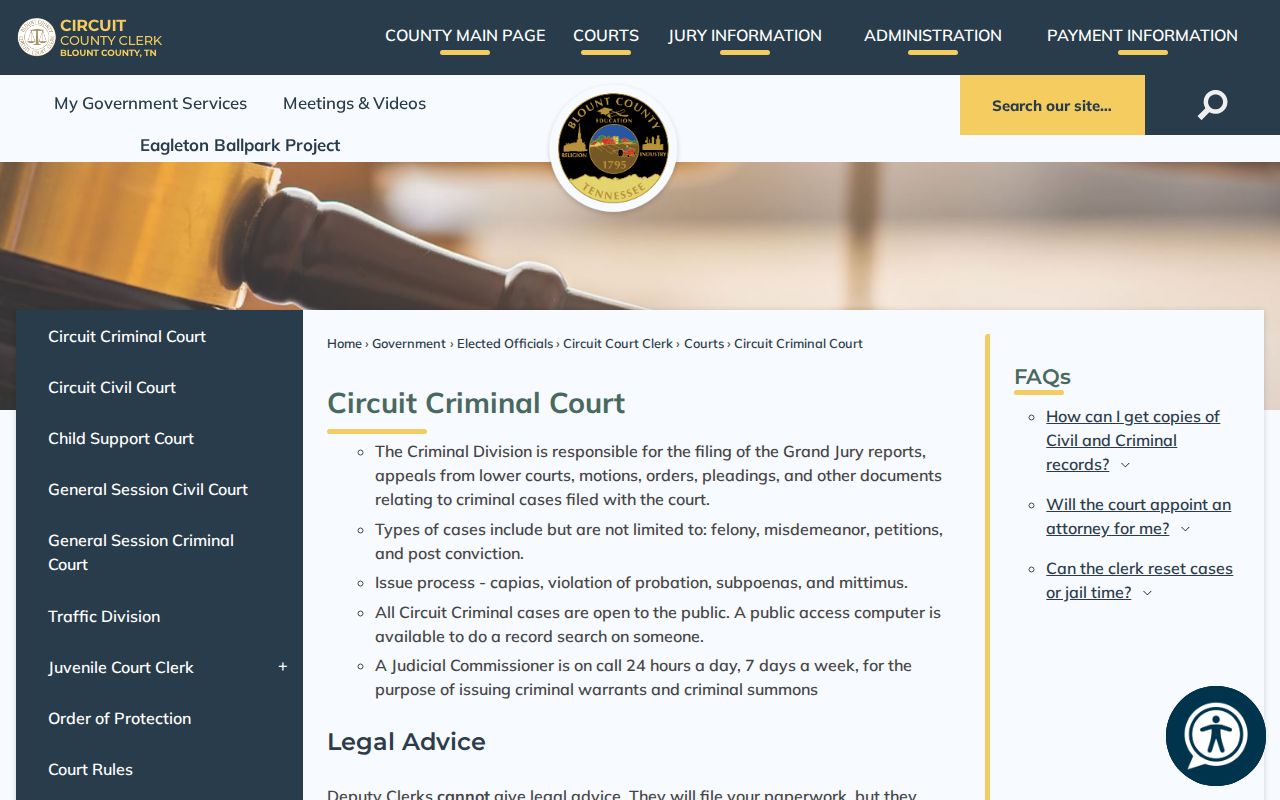
That court page confirms that the clerk, rather than a statewide trial portal, is the key source for Blount County criminal court cases.
Blount County Criminal Court Jurisdiction
A misdemeanor can begin and end in General Sessions. A felony usually starts there for its preliminary stage, then may continue through the grand jury and Circuit Criminal. Circuit also receives criminal appeals from lower courts. This is why a name and charge alone may not locate every paper. The division, docket number, and stage narrow the search.
The General Sessions Criminal Court page explains its misdemeanor and preliminary-hearing role.
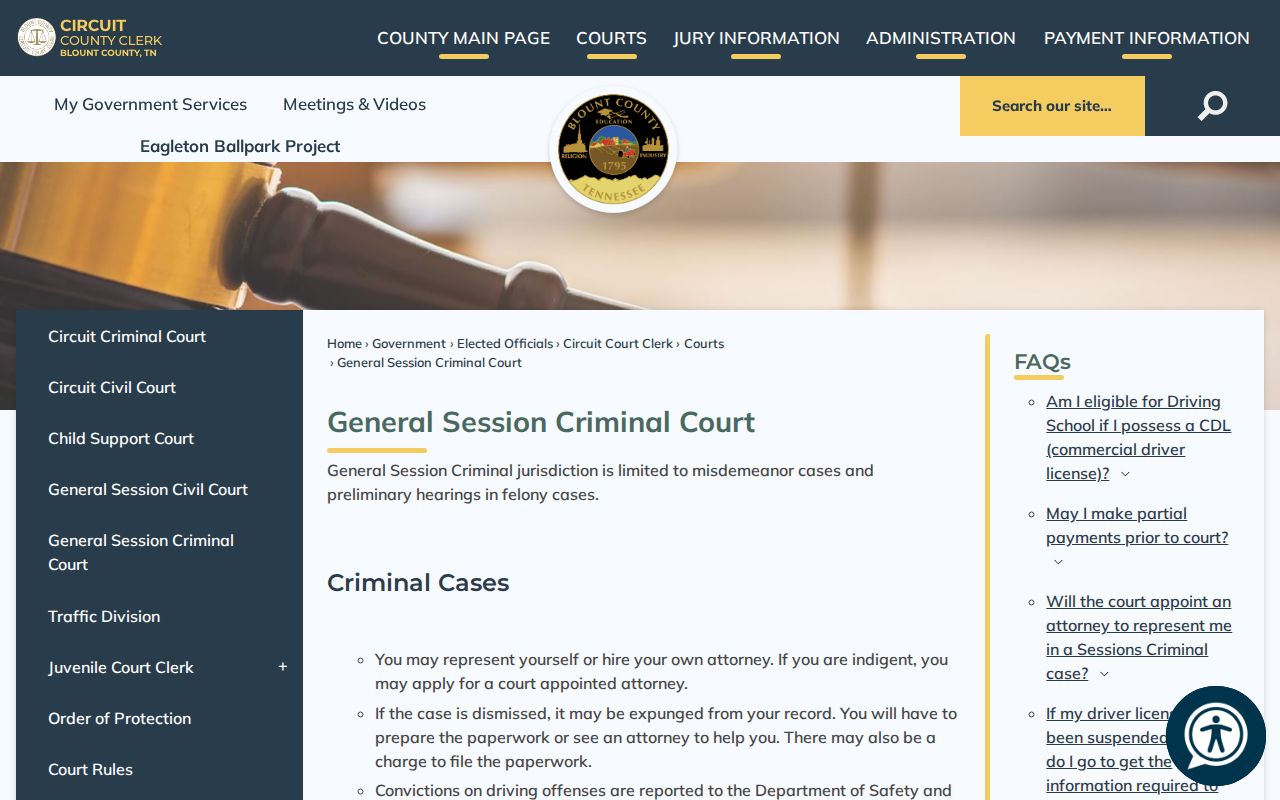
For a felony inquiry, check General Sessions first when the case is new, then ask whether a Circuit Criminal docket was opened. Courtfeepay is only a payment channel. It is not proof that Blount County offers an online public case-name database.
How to Search Case Records
There is no comprehensive official internet portal for Blount County trial cases. The most direct search uses the public computer at the Blount County clerk's office. A phone inquiry, counter request, mailed Form A, or written copy request can serve when an onsite search is not practical. Tennessee's appellate case tools cover appeals, not the whole local trial docket. Use this sequence:
- Decide whether the matter belongs to General Sessions or Circuit Criminal based on its misdemeanor, felony-preliminary, appeal, or post-conviction stage.
- Gather the defendant's name, an approximate date range, and any known case or docket number.
- Search the clerk's public terminal or call the correct division and ask staff to locate an existing record.
- Review docket entries, charges, hearings, orders, and the judgment before treating a status as final.
- Inspect at no charge or submit a written request for paper, electronic, or certified copies.
The public terminal's exact labels are not posted online. The fields below are identifiers the clerk's policy and court materials support for a search or records request, not claims about a web form.
| Search Identifier | Format | Use | Notes |
|---|---|---|---|
| Defendant name | Text | Starting identifier | Similar names can return the wrong file |
| Case or docket number | Text | Best direct match | Often appears in booking or court papers |
| Date range | Date or year | Narrows the filing period | Use an approximate range if needed |
| Charge or record type | Text | Separates similar matters | Name the criminal division when known |
| Court division | General Sessions or Circuit | Routes the request | Felonies may have records in both stages |
Blount County Case Record Requests
Inspection requests need not be written under the Blount County clerk's policy. A request for copies, or inspection plus copies, must be submitted in writing. The clerk's public-records policy links Form A and explains the response process. It requires proof of Tennessee citizenship and enough detail to identify an existing record. The office does not have to create a new report or compilation.
The official policy page presents the request rules and form route used for Blount County criminal case records.
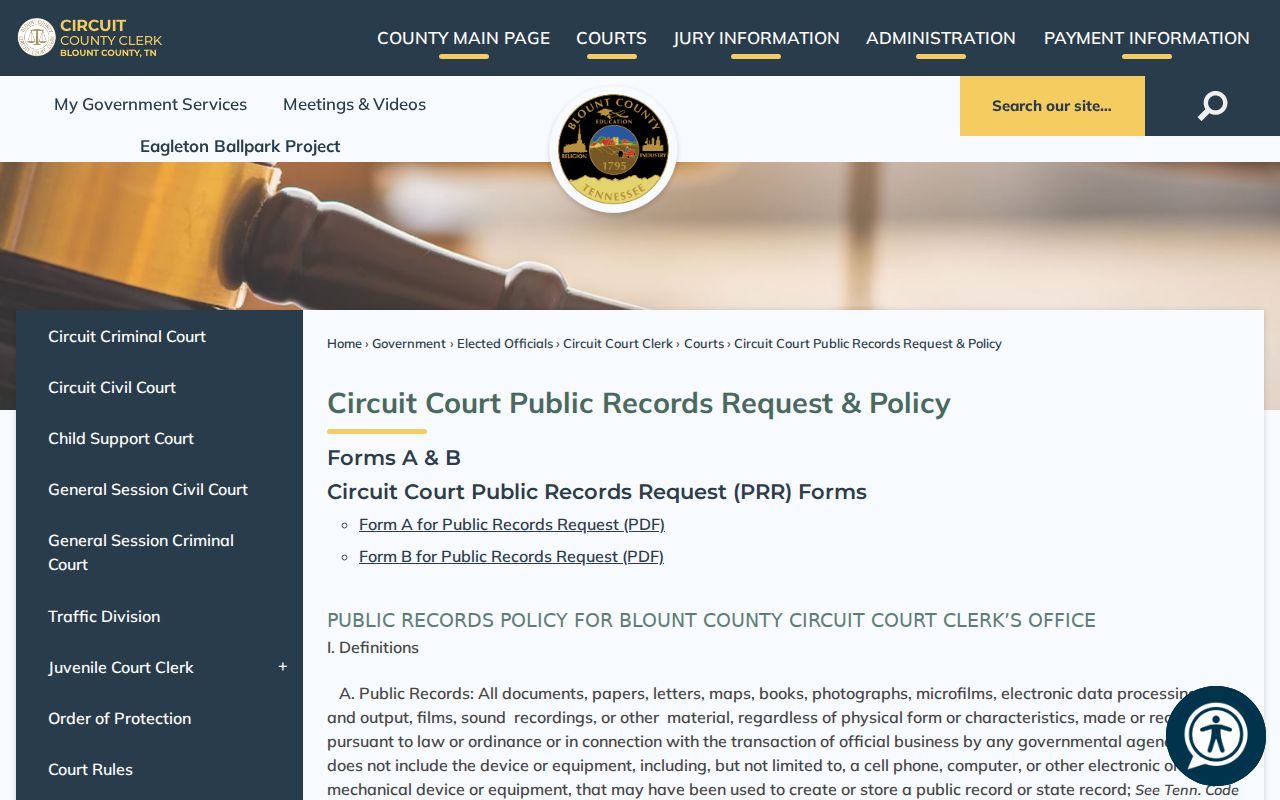
Form A asks for the requester's name, contact information, date, Tennessee-citizen status, inspection or copy choice, delivery preference, and a detailed description. When prompt production is not practical, the clerk has seven business days to provide the record, deny with a basis, or give a production schedule. Copies cost 50 cents per page. Certification adds $5, plus the page charge. Labor beyond one hour is $22 per hour, and prepayment may be required when the estimate exceeds $25.
What the Case File Shows
A court file records the prosecution after charges reach the clerk. Its value is the sequence: the charging paper, settings, pleas, motions, orders, judgment, and sentence. A single file does not always contain every field below, and confidential attachments may be removed or redacted. Still, these are the main items to request when reading Blount County criminal court cases.
| Case Number and Court | Identifies the docket, division, filing date, and often the assigned judge. |
|---|---|
| Charging Document | States the filed counts, alleged offenses, statutes, and severity. |
| Docket Entries | Lists hearings, filings, minutes, motions, pleadings, and orders in sequence. |
| Process and Bond | May include a warrant, summons, capias, subpoena, mittimus, or bond action. |
| Disposition and Judgment | Shows the court's result, such as dismissal, plea, acquittal, or conviction. |
| Sentence and Costs | Records custody or probation terms, fines, costs, and reported payment history. |
TBI's TORIS history is different. It links fingerprint-based arrest cycles to reported outcomes, while the Blount County court file holds richer pleadings and docket detail. Verify a missing or unclear disposition with the clerk.
Blount County Criminal Docket Terms
Several short terms mark where a Blount County criminal case stands. Reading them in context helps prevent a process entry from being mistaken for a final result.
- Arraignment
- The first court appearance at which charges are addressed and a plea may be entered.
- Capias
- Court process often issued after a failure to appear or another post-filing event.
- Disposition
- The outcome of a charge, which may differ from the original arrest label.
- Mittimus
- A court order directing custody or carrying out a sentence.
- Post-conviction petition
- A later filing that challenges a conviction or sentence through a defined court process.
Only the docket and signed order establish current status. A bond entry is not a verdict, and a release from jail is not a dismissal.
Stages of a Criminal Case
Blount County Judicial Commissioners work around the clock under General Sessions judges. They may issue warrants or summonses, arraign an arrested person, set bond, and set a court date. The prosecutor then decides what charges to pursue. A misdemeanor may remain in General Sessions, while a felony can proceed through a preliminary hearing, grand jury, and Circuit Criminal.
Case flow: Charges Filed › Arraignment › Pretrial › Plea or Trial › Disposition › Sentencing
The Blount County judges directory identifies Circuit, General Sessions, and judicial-commissioner roles.
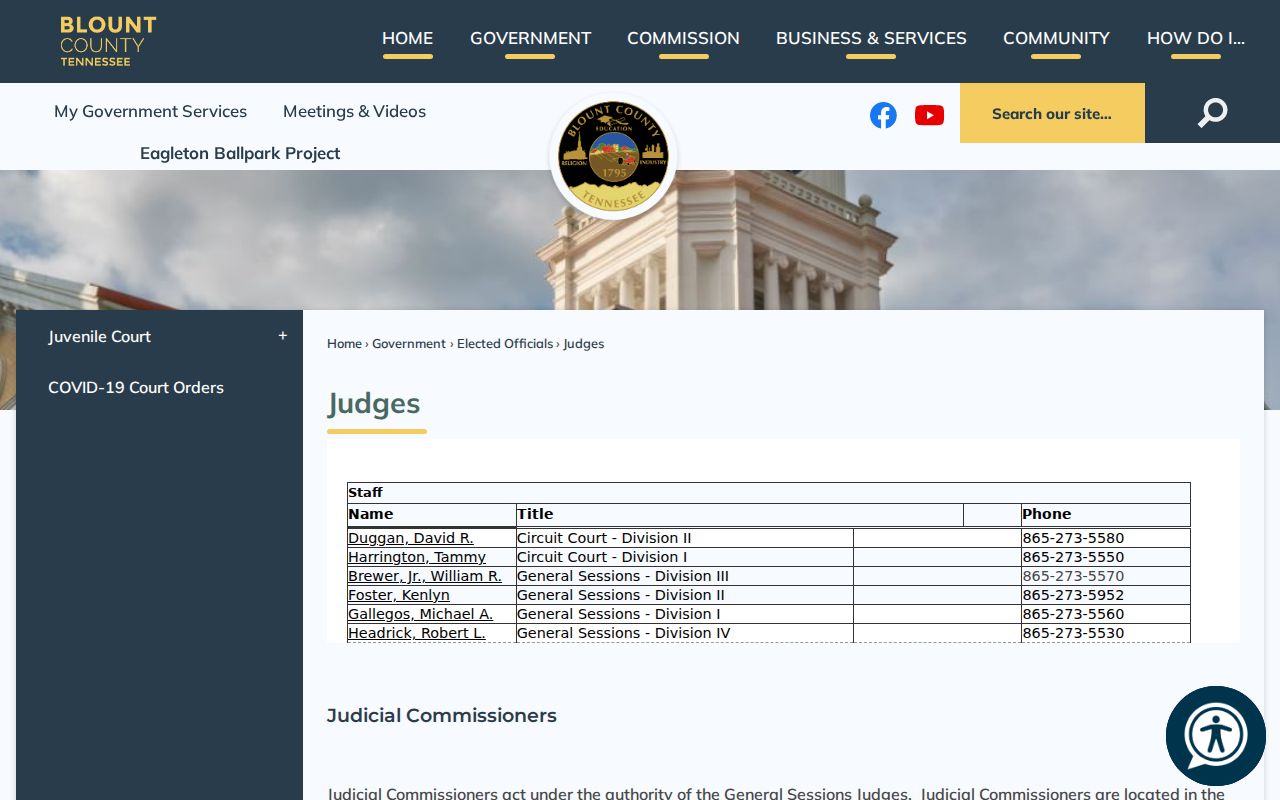
This structure explains why a fresh case may have a bond and first date before a full Circuit Criminal file exists.
Older Blount County Case Records
A historic criminal search may belong at Blount Records Management and Archives rather than the active clerk counter. The archive holds Criminal Court material from the 1930s through 1991, Circuit material from 1894 through 1992, and General Sessions State material from 1972 through 1992. It also preserves county records dating to Blount County's founding in 1795.
Call 865-380-4295 before visiting 1229 McArthur Road in Maryville. Onsite research requires an appointment. Archives directs active Circuit files back to the clerk, so give the estimated year, court division, subject name, and case number when known. That simple date split can save a trip between offices.
Access & Restrictions
The Blount County clerk describes nonjuvenile General Sessions and Circuit Criminal cases as open to the public. Tennessee's Public Records Act supports inspection of existing government records, but it does not erase specific confidentiality laws. Juvenile files, expunged or sealed matters, protected victim details, personal identifiers, and confidential attachments may be withheld or redacted under the applicable rule.
An absent terminal result is not proof that no case exists. Check the spelling, date range, division, and docket number. Ask whether the matter moved from General Sessions to Circuit, reached a federal court, or falls in an archived year. The clerk must cite a basis for a denial, but staff need not create a new summary.
Blount County lies in the Eastern District of Tennessee. A federal prosecution uses PACER, not the county terminal, while Tennessee appellate tools cover cases that reached a state appellate court. Neither system replaces the local clerk's General Sessions and Circuit Criminal files.
Tennessee access rule: Tenn. Code Ann. §§ 10-7-503 and 10-7-504 govern public-record access and exemptions; juvenile access is separately limited, and expunged records are not public court files.
Blount County Criminal Case Offices
The clerk supplies records. The District Attorney prosecutes cases, and the Public Defender represents eligible people only after court appointment. Neither lawyer's office replaces the court-record counter.
Circuit Court Clerk
926 E. Lamar Alexander Parkway
Maryville, TN 37804
865-273-5400
General Sessions Clerk
926 E. Lamar Alexander Parkway
Maryville, TN 37804
865-273-5450
The official Public Defender page explains that representation depends on court appointment.
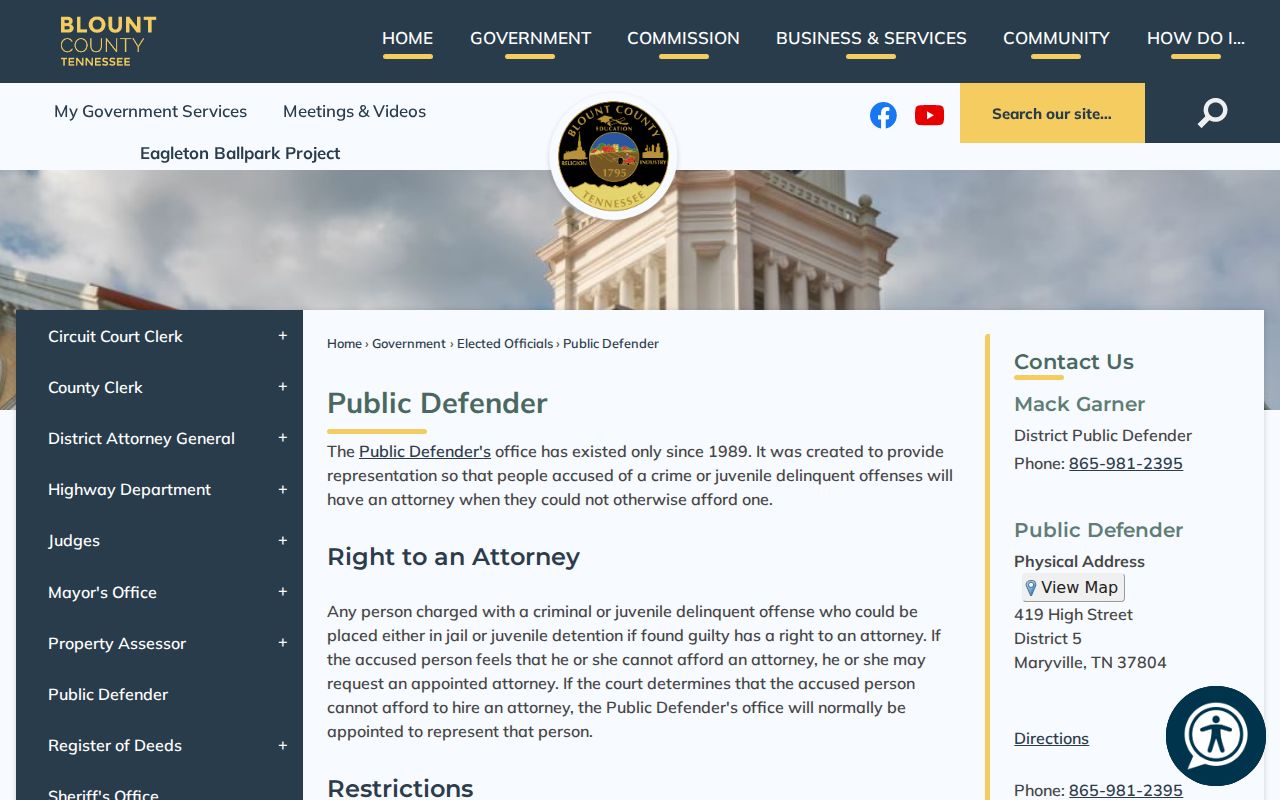
That distinction helps keep record requests with the clerk and legal representation questions with the appointed defender.