
How to Check Criminal History in Louisville
Begin a Louisville criminal record search by deciding whether the need is a police report, a current booking, a court outcome, a town ordinance record, or a Tennessee repository history. Louisville Town Hall keeps town business records and complaint forms. It does not keep a city police blotter. The Blount County Sheriff's Office is the law-enforcement custodian because deputies supply Louisville police services.
- For a Louisville incident or police report, use BCSO GovTransfer, call the sheriff's Records Office, email reports@bcso.com, or visit its Maryville counter.
- For current Louisville arrest custody, check BCSO InmateNOW or call Adult Corrections. No separate Louisville jail roster exists.
- For charges and results, use the Blount County Circuit Court Clerk's public terminal, phone, counter, mail, or written Form A request.
- For town complaints, meeting files, or ordinance administration, use Louisville's public-record and complaint repository or call Town Hall.
- For a Tennessee name-based history, use TBI TORIS and understand that its fingerprint-source data has a different scope from a Louisville report.
Keep an incident number, booking number, docket number, date range, and exact name when available. Those details help the sheriff or clerk locate an existing Louisville record without creating a new compilation.
Why Louisville Has No Police Records
The official Louisville emergency page states that BCSO provides all police protection. The town has contracted with BCSO since 2017. A March 2026 town explanation says Louisville lacks the revenue to create, staff, and insure its own police department. This is not just an administrative detail. It decides where an incident report, arrest report, or deputy record must be requested.
The official Louisville notice shows the sheriff-service arrangement rather than a city police agency.
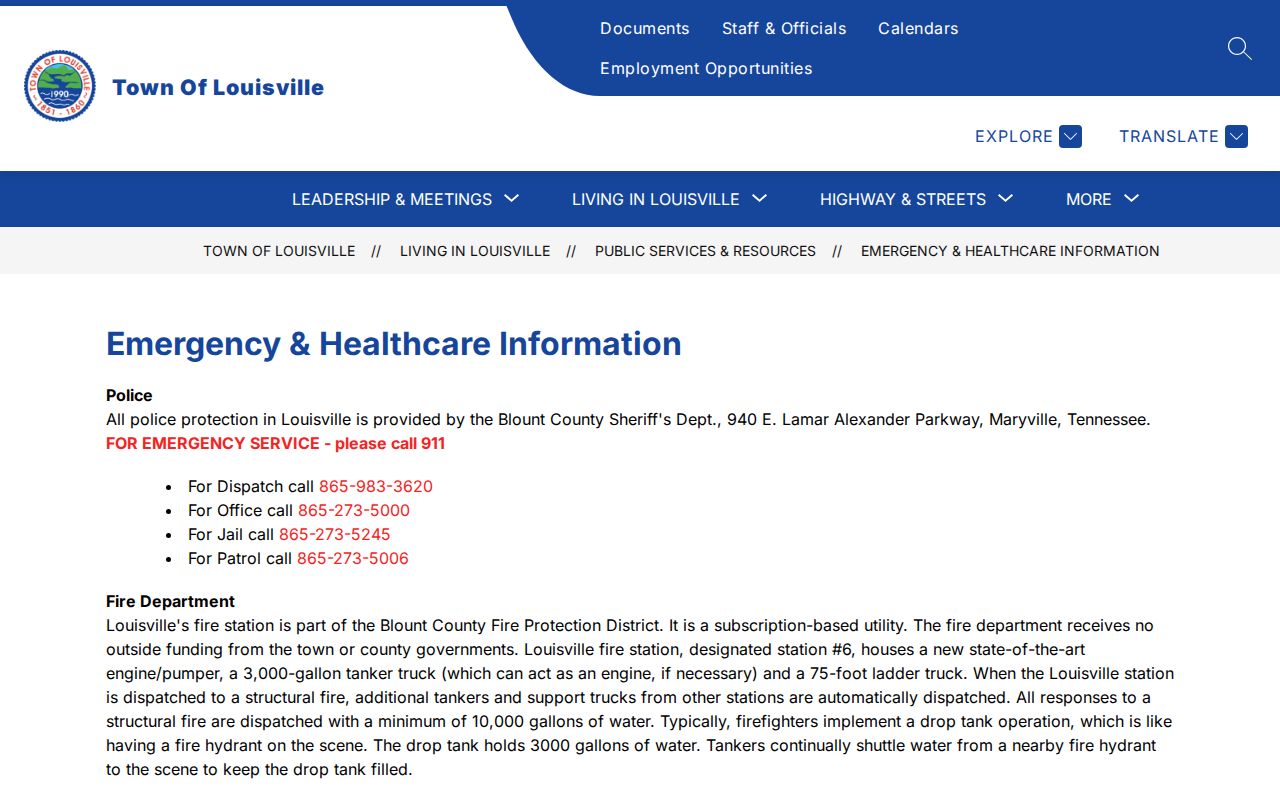
The image confirms the town's routing rule. Louisville Town Hall cannot act as a police records counter merely because an event occurred within town limits. Send police files to BCSO. Emergency calls go to 911, while dispatch is 865-983-3620, sheriff headquarters is 865-273-5000, patrol is 865-273-5006, and the jail is 865-273-5245.
The Louisville Police Department
There is no Louisville Police Department. BCSO deputies carry out police work within the town, and the BCSO Records Office maintains sheriff incident and arrest reports. The records office also handles adult criminal-history material, detention records, TIBRS reporting, and certain NCIC functions. Those internal law-enforcement systems are not all public search products. A Louisville requester receives public material through the sheriff's actual release channels.
Town officials and BCSO also use an interlocal agreement for selected Louisville ordinance enforcement. Deputies can address animal and nuisance issues, barking dogs, noise, property maintenance and safety, trash and litter, zoning, and public-safety provisions. This role does not turn BCSO into a municipal police department. It also does not create a Louisville criminal-history portal. The report still belongs with the sheriff, while town administrative material may remain at Town Hall.
Note: A Louisville mailing address does not by itself prove that an incident occurred within the incorporated town or under a town ordinance.
Requesting Louisville Police Reports
Use BCSO GovTransfer for a Louisville police report, subpoena, or formal public-record request. The portal requires account creation before the complete agency form appears. Because the public entry does not disclose every field, fee, or turnaround term, do not assume the form matches a general Blount County request. Describe the date, place, parties, incident number, and record sought as precisely as the known facts allow.
Alternative Louisville report channels remain important. Call BCSO Records at 865-273-5003, email reports@bcso.com, or visit 940 E. Lamar Alexander Parkway in Maryville. The office is open Monday through Friday, 8:00 a.m. to 4:30 p.m. No current sheriff-specific base fee appears on the public Records Office page. Ask for an estimate rather than borrowing the clerk's court-copy schedule.
BCSO Records Office
940 E. Lamar Alexander Parkway
Maryville, TN 37804
865-273-5003
reports@bcso.com
Monday-Friday, 8:00 a.m.-4:30 p.m.
Louisville Town Hall
3623 Louisville Road
Louisville, TN 37777
865-681-1983
Town records only, not police reports
Arrests and Bookings in Louisville
Louisville operates no jail. A custodial arrest made by BCSO routes to the Blount County Adult Detention Center, whose inmate-mail and facility address is 920 E. Lamar Alexander Parkway in Maryville. BCSO InmateNOW provides the official current inmate and booking view. It can show intake time, booking and name numbers, charges, bond, court, docket number, and court date.
A Louisville event does not receive a separate town booking label simply because it happened within Louisville. The same BCSO system holds people booked from sheriff calls across the service area. A current list may change after release, and a release reason does not establish dismissal. For a deeper explanation of the custody fields and fallback channels, use the county's Blount County arrest history resource.
When Louisville Arrests Are Not Online
No official Louisville arrest blotter or town booking log exists. If a recent event does not appear in InmateNOW, call BCSO Adult Corrections at 865-273-5245. A person may have been released, held in another facility, cited without entering the county jail, or booked under details that do not match the search. An online absence cannot clear an arrest or warrant question.
For an older Louisville arrest, ask BCSO Records for the report or detention file through GovTransfer, phone, email, or the counter. Then use any docket number to ask the Blount County clerk for the case result. State felony custody or supervision can later appear in TDOC FOIL, while TORIS addresses Tennessee fingerprint-linked criminal history. These are successive records, not interchangeable copies.
Louisville Municipal Court Records
Louisville has no operating municipal court. The current official municipal code reserves Title 3 for possible future municipal-court use. It does not establish a present clerk, docket, hearing schedule, payment portal, or Louisville court-record search. The town's BCSO ordinance arrangement did not change that status.
| Court Name | No operative Louisville Municipal Court is identified in the current code. |
|---|---|
| Code Status | Title 3, Municipal Court, is reserved for future use. |
| Criminal Case Court | Blount County General Sessions handles misdemeanors and felony preliminary matters. |
| Felony Court | Blount County Circuit Criminal receives felony cases that advance. |
| Case Lookup | Public terminal, phone, counter, mail, or Form A through the Blount County Circuit Court Clerk. |
Do not treat a town complaint form as a criminal docket. Louisville administrative records may document a nuisance report or ordinance issue, but the county clerk holds any state criminal case that follows.
Louisville Ordinance Records vs Criminal Cases
The 2026 Louisville explanation says BCSO may enforce listed town rules alongside county law. Fines are capped at $50 for each violation, and enforcement costs reduce what the town receives. That cap is an ordinance fact, not evidence of a criminal conviction search. Noise, barking-dog, litter, property, zoning, and similar records can begin as town complaints or deputy reports without creating an operative Louisville municipal-court file.
| Record | Likely Custodian | What It Shows |
|---|---|---|
| Town complaint | Louisville Town Hall | Administrative complaint or ordinance correspondence |
| Deputy incident report | BCSO Records | Sheriff response and investigation facts |
| Booking entry | BCSO Adult Corrections | Custody, charges, bond, and next court data |
| State criminal case | Blount County Circuit Court Clerk | Filed charge, hearings, orders, and disposition |
A Louisville ordinance file and a Blount County criminal case can arise from related facts, but one should not be used as proof of the other. Match each record to its named custodian.
Where Louisville Records End Up
A Louisville criminal incident begins with a BCSO report because the sheriff supplies town policing. If custody occurs, BCSO Adult Corrections creates the booking. If prosecutors file a state criminal case, the Blount County Circuit Court Clerk maintains General Sessions or Circuit Criminal records. Fingerprints and later reported events can flow to the Tennessee Bureau of Investigation's repository.
Record flow: BCSO report › BCSO booking when custody occurs › Blount County Courts › Tennessee Bureau of Investigation
Recent activity is most likely to appear with the sheriff. A court outcome belongs with the clerk. TORIS is a Tennessee name-based product built from fingerprint submissions and costs $29 per request, but it is not a Louisville-only search. This routing keeps the city page at Louisville altitude while recognizing the county offices that actually hold its criminal records.
Louisville Town Records Since 1990
Louisville's public files reflect a town with a broken municipal timeline. River trade drove an 1840s boom. Louisville incorporated in 1851, later lost that status, and reincorporated in 1990. Fort Loudoun Dam was completed in 1943 and flooded an estimated 70 percent of old Louisville. Those events help explain why town administrative history and present criminal justice records do not sit in one continuous city police or court archive.
The official Town Hall and community center page identifies the building completed in 2011.
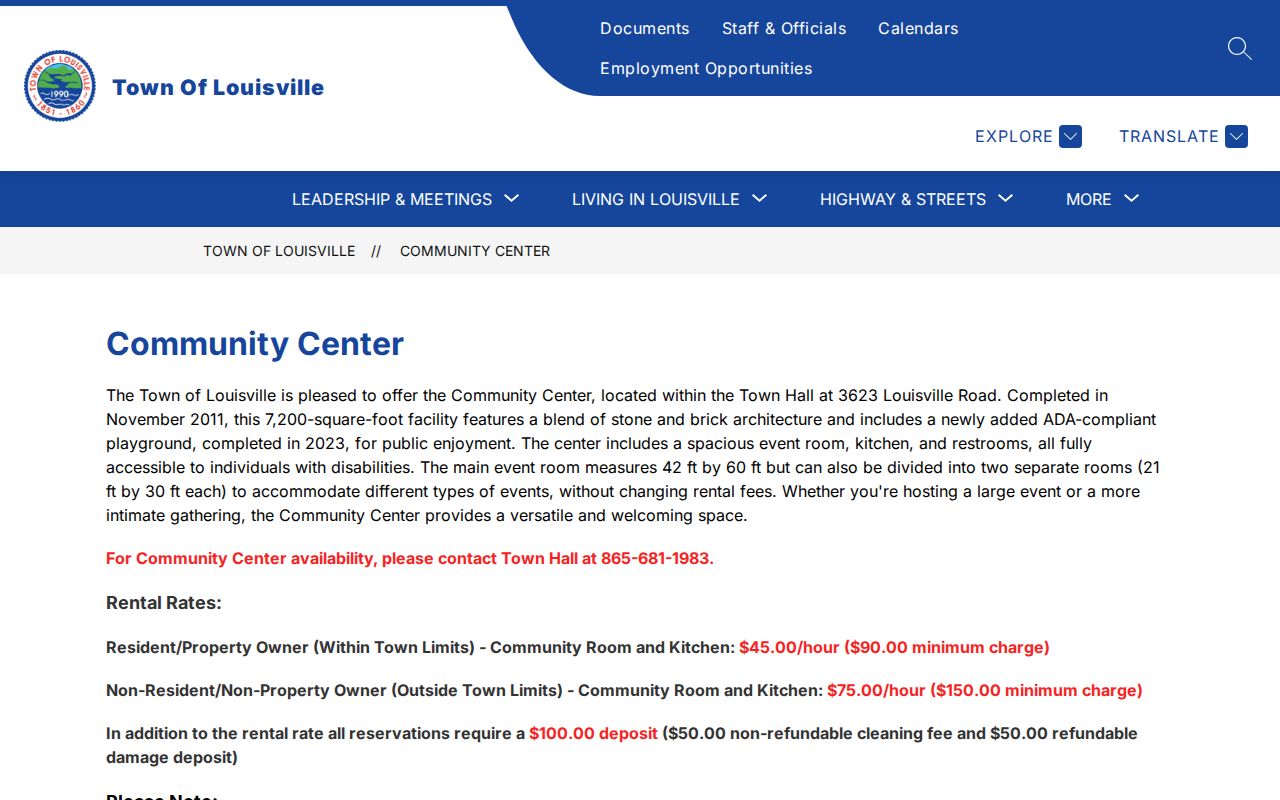
This is Louisville Town Hall, not a police headquarters or municipal courthouse. The office at 3623 Louisville Road keeps town material and offers split weekly hours: 8:30 a.m. to 4:30 p.m. Monday, Tuesday, and Thursday, then 8:30 a.m. to 1:00 p.m. Wednesday and Friday. Call 865-681-1983 for town records.
Public Access Rules
The Tennessee Public Records Act governs access to existing public records at Louisville and county custodians, subject to specific exemptions. Inspection requests may be oral in some settings, but a written request is often the clearest route for copies. The request should identify the record, date range, and subject with enough detail to find it. An office need not create a new report or compilation.
Key Statutes:
Tenn. Code Ann. § 10-7-503 defines public records and sets the basic right and process for access.
Tenn. Code Ann. § 10-7-504 gathers confidentiality rules and permits lawful redaction of protected information.
Tenn. Code Ann. § 40-32-101 governs expungement pathways and limits public access after qualifying records are removed.
Juvenile files, expunged or sealed records, protected victim information, personal identifiers, and confidential attachments may be withheld or redacted under the law that applies. Ask the custodian to identify the basis for a denial rather than assuming every Louisville police or court-related record is either fully open or fully closed.
Louisville Arrest Statistics Need Care
Louisville has no standalone police department, so it has no separate city PD annual arrest series. BCSO's published agency counts cover the sheriff's broader service and cannot be relabeled as Louisville crime. Even an event count tied to a Louisville postal address might fall outside incorporated limits. These jurisdiction lines matter when reading local criminal records.
Countywide and BCSO figures can provide context only when their scope and year remain clear. They do not show the number of Louisville residents arrested, the number of unique people, or the number of convictions. For a particular event, use the sheriff report, booking identifier, and court docket. For historical study, Town Hall can address municipal files, while older county court materials may be held by Blount Records Management and Archives.
Louisville's 2025 population estimate places it third among Blount County's incorporated cities, but population rank does not create a local police data set. Maryville and Alcoa can publish their own department workload because each runs a city agency. Louisville cannot. A responsible comparison must label a BCSO number as sheriff-wide and preserve its year. For a narrow Louisville question, an incident-level request is more useful than a broad agency total. It ties the place, date, report, and later docket together without implying that all sheriff activity occurred in town.